
Regis College, the Jesuit School of Theology in Canada and a work of the Jesuits of Canada, stands at a dynamic crossroads of faith, culture, and education. Rooted in the Ignatian tradition and strengthened by partnerships within a network of relationships — with the Jesuits of Canada, the Jesuit Conference of Canada and the United States (JCCU), the University of St. Michael’s College (USMC), the Toronto School of Theology (TST), the University of Toronto (U of T), and the global Jesuit Collaborative Theological Initiative — we embrace a mission that is both timeless and urgently relevant. Our recent federation with USMC marks a new chapter of collaboration, expanding our capacity to form leaders who will serve with wisdom and compassion in a world marked by complexity and fragmentation.
As a Jesuit school of theology in collaboration with the Regis St. Michael’s Faculty of Theology, the College serves students as they grow in their capacity to promote faith and justice; to be persons of intellect and compassion, who are animated by humility and gratitude. Through the tools of discernment and rigorous academic training, Regis fosters a deepening sense of mercy, beauty and the transcendent. Such an education, rooted in a faith tradition, disposes our students to be available with generosity for the greatest variety of lay and ordained ministries – with special preferences to show the way to God, walk with the excluded, journey with youth, and care for our common home as they grow in freedom as agents of change.
Education in the Jesuit tradition accomplishes this:
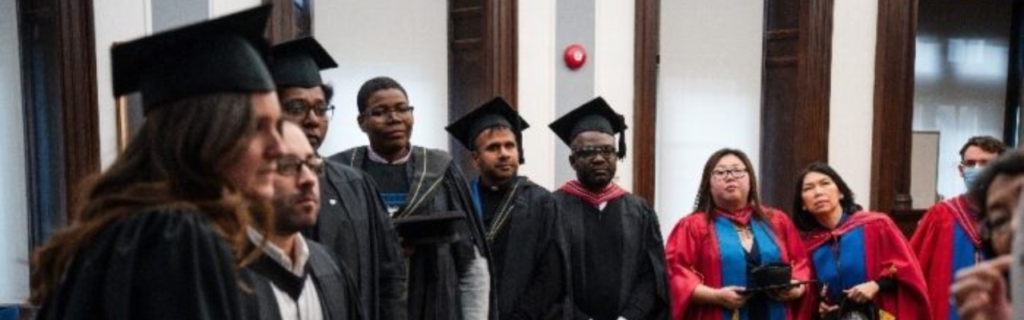
We educate women and men for ministry in the church in various capacities and in the academy as scholars, researchers, and teachers. We believe that scholarship and ministry are not separate paths but a shared journey. We affirm Regis College as a distinctive place where Jesuit and lay vocations are formed together, and where women’s leadership and scholarship are essential to the life of the church. Formation at Regis College is shared, differentiated, and reciprocal—embracing Jesuits, lay women and men, students, staff, faculty, and members of Regis governance bodies as co-participants in a common mission.
Through the charism of the Society of Jesus, Regis draws on the insights of the Spiritual Exercises of St. Ignatius of Loyola in forming scholars and critical thinkers grounded in academic rigour who pursue truth, practice justice, and live out their faith in integrity. Theology at Regis College is intellectually cutting-edge, culturally diverse, engaged in ecumenical, interfaith and cross-cultural dialogue, and practical in its engagement with the world in transformative global service, especially with persons excluded from wealth and power. We nurture hope where it is most needed, standing beside those who hunger for truth, bear the weight of injustice, or long for healing. Our mission is simple yet demanding: to make Christ known with courage, generosity, and joy. Guided by love and grace, we work for a world where reconciliation with God, with others, with oneself, and with creation is not an aspiration but a lived reality. We share a bold vision: to engage culture constructively, to seek God in all things, and to foster a faith that acts for justice and reconciliation.
Regis promotes a vibrant culture of faculty research and academic excellence, serving as a centre of intellectual inquiry. Faculty members actively contribute to scholarly conversations through innovative research, interdisciplinary collaboration, and publication, enriching both teaching and learning. This commitment ensures that students engage critically with ideas, develop rigorous analytical skills, and participate in a dynamic academic environment that fosters curiosity, reflection, and the pursuit of knowledge in service of a wider community.
This strategic plan builds on that foundation. It charts a course for the next chapter of our mission, guided by three convictions:
We will deepen our commitment to forming compassionate leaders — scholars and ministers who listen closely, accompany patiently, and engage culture constructively. Our programs will integrate theology, spirituality, and social justice, fostering a faith that seeks understanding and action.
In a complex university environment, we will strengthen partnerships and create innovative pathways for learning and research. Our federation with USMC is not an endpoint but a springboard for new initiatives that amplify our shared mission.
At a global crossroads, we will extend our reach to communities near and far, responding to the needs of the Church and the world. We will nurture reconciliation with God, with others, with oneself, and with creation — convinced that love is trustworthy and the Gospel can touch every wound.
This plan is not merely a roadmap; it is a call to action. It invites every member of our community to walk together toward a hope-filled future, inspired by the daring spirit of Ignatius and his followers. This vision commits us not only to proclamation and service, but to ensuring that our internal culture reflects the care, justice, and dignity we seek to advance in the world. Our mission remains simple and demanding: to make Christ known where his presence is needed most.