


31 Mar Global Crossroads (from Regis Friends Quarterly 4.3)
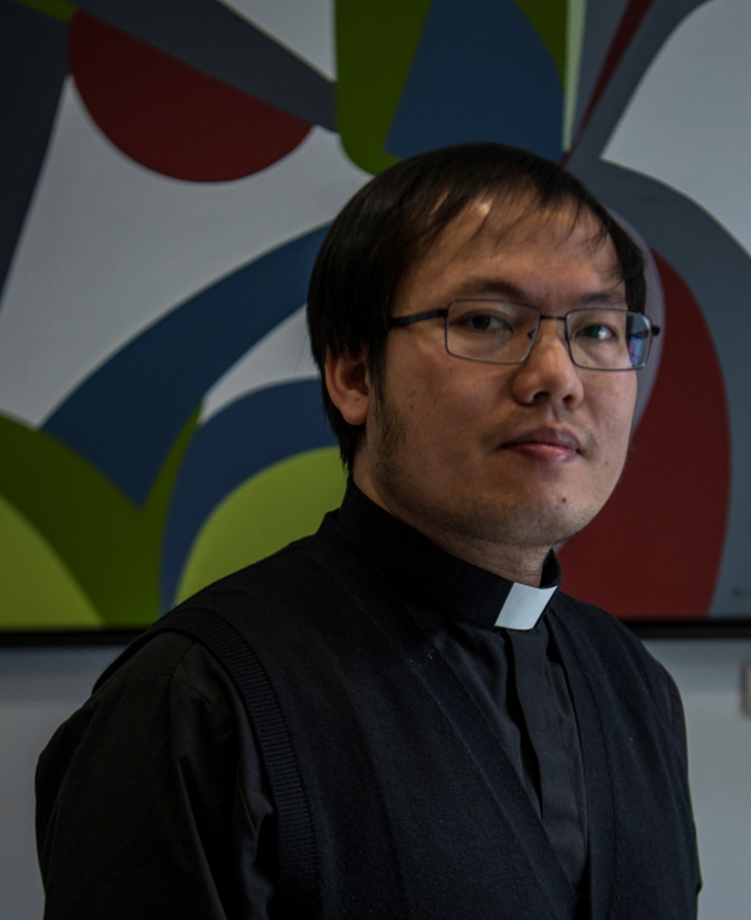
The journey from the Nuba Mountains to Khartoum to Toronto covers about 11,000 kilometres. The journey in faith from Sudanese Pentecostal to Catholic to Jesuit priest is immeasurable. Fr. Nahum Osman Gidiel Alysar, SJ, is almost certainly the only pilgrim in Christian history to have made these parallel trips, and Regis College is grateful to be a way-station on Alysar’s continuing odyssey.
“Just to be able to have a student from Sudan is a real gift,” Alysar’s thesis advisor Prof. John Dadosky told RFQ. “My students teach me.”
Born in South Kordofan State and internally displaced at four years old by the war that gave birth to South Sudan, Alysar grew up as part of a despised and feared minority amidst the militarized Islamic politics of Sudan. It is perhaps inevitable and almost certainly a miracle that Alysar is studying Muslim-Christian dialogue as he works his way to a Master of Theology (MTh) and Licentiate in Sacred Theology (STL) at Regis.
As part of the Indigenous Nuba people of Sudan, Alysar feels deeply the new, contemporary violent crisis of civil war in Sudan, between the Sudanese Armed Forces and the Rapid Support Forces, raging since 2023.
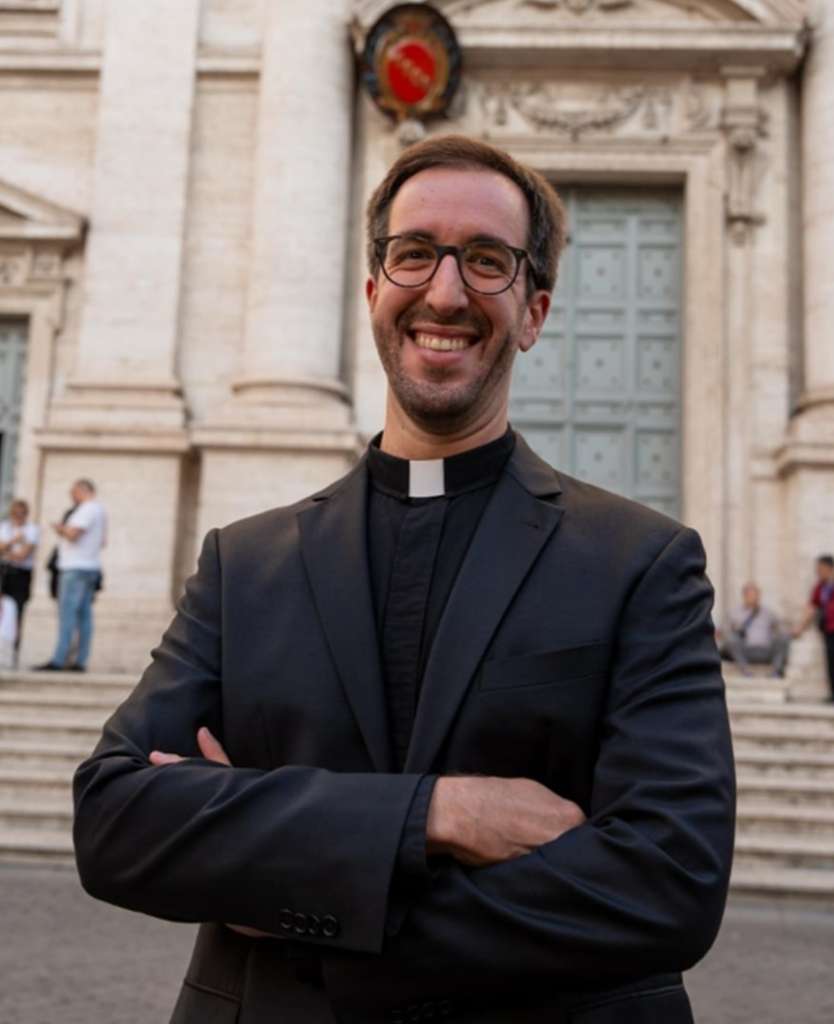
Julio Minsal-Ruiz, SJ
“The two groups are using the name of Allah (God) in this fight. They have caused so much pain and massive displacement to the Sudanese people,” Alysar wrote in an email. “Amid all this, here I am as a Jesuit priest in Toronto, particularly at Regis College, pursuing a Master of Theology in a very conducive environment, and reflecting deeply on the purpose of human existence.”
Perhaps the oddest thing about Alysar’s story is that, despite his uniqueness, he is not alone. More than thirty different countries are represented in the Regis student body today, and over the last 30 years the college has produced alumni from more than 60 nations. Of the 176 students at Regis St. Michael’s Faculty of Theology, 47 are international students, or about 27 per cent.
Canada’s welcome of international students has been front-page news for months, with the federal government now sharply reversing a policy that drew thousands to study in Canada. In the first nine months of 2025 the number of graduate students at Canadian universities dropped by 46 per cent compared with the same period in 2024. Where in 2024 there were 28,605 new study permits issued to graduate students, that number was down to 15,390 in 2025. But Regis continues to value international students for what they bring to the learning community.
The logic of a Jesuit graduate school of theology seeking to gather the world into its student body could not be more obvious to Dadosky.
“There’s 1 billion Catholics, so it’s important to have a theology school that represents a diverse population of 1 billion Catholics, as much as we can,” he said.
In his time at Regis (2016-2019), Fr. Julio Minsal-Ruiz, SJ, came to understand Christianity differently because of the diverse, multicultural nature of the student body and the city. A Puerto Rican by way of Miami, Minsal-Ruiz found himself in Toronto helping with the Rite of Christian Initiation for Adults at the University of Toronto’s Newman Centre. Those seeking baptism and confirmation included Anglo-Canadian refugees from the culture wars, people from Toronto’s youth subcultures and a Turkish Muslim who told him that if people back home in small-town Turkey knew she was converting, her life might be in danger.
My Joseph, SJ
Each of them was an addition to the Church. “This, I think, is the gift of what basically Christianity can do,” Minsal-Ruiz said on a Zoom call from the Gregorian University in Rome, where he is now seeking a doctorate. “It allows different parts, different cultures, different forms, different thought systems, different philosophies to come into engagement with the centre – and to still be related to one another.”
From regency in the Mekong Delta to theology studies in downtown Toronto, Vietnamese Jesuit scholastic My Joseph, SJ, has crossed cultural barriers to study theology. Over the last year he has had to squeeze his understanding of the faith he loves into a language that can’t help but feel wrong.
“My English speaking is not really good, you know. Sometimes I could not explain my idea clearly,” My confessed. “But you know, the more I studied here, the more I also recognized that my classmates respect my opinion. That gives me more confidence to respect myself. Yeah, they help me a lot to deepen the topic.”
Normal Canadian classroom dynamics, which lays a heavy emphasis on student contributions to classroom discussions and debate, were completely foreign to My before he arrived at Regis.
“The way to study is different… The method here involves the students in really constant classroom conversation, discussion,” he said.
If he had studied theology in Ho Chi Minh City (Saigon) a Vietnamese professor would have lectured for hours to a classroom of Vietnamese men, all of them studying for the priesthood. Some professors ask for questions from students, but it’s strictly an extra feature, tagged onto the end of a lecture, My said.
“Quite a lot of things are different (at Regis)” My explained. “The environment, hunh? You see, here there is more diversity… Many different professors. Very diverse. I have a chance to meet with the international students who come from different countries… That broadened my view about the world, about Christianity.”
As he studies for a Master of Divinity, My wants to learn from his classmates.
“I want to know about how they understand church teaching in their own context – teaching about liturgy, about the way they adapted liturgy to their own culture,” he said. “This becomes an invitation to myself to open myself more to different people and other cultures. It also helps me to slow down my judgment of different things that I do not understand deeply. That is my privilege. I believe that will also stay with me in the future.”